
Bite problems can affect much more than the way your teeth look. An overbite, underbite, or crossbite can make chewing feel uneven, create wear on certain teeth, and sometimes contribute to jaw discomfort or speech concerns. Many patients ask whether clear aligners can correct these issues without traditional braces.
The short answer is that Invisalign can help with many bite problems, but not every case is the same. Some mild to moderate bite concerns respond very well to aligner therapy, while more complex jaw-related problems may require additional treatment or a different orthodontic approach.
If you are searching for whether Invisalign can fix overbite, underbite, or crossbite, this guide explains what Invisalign can do, where its limits are, and what treatment usually involves.
Can Invisalign Fix Bite Problems?
A bite describes how your upper and lower teeth come together when you close your mouth. When the teeth or jaws do not align properly, it can create a malocclusion, which is the dental term for a bite issue.
The most common types include:
Overbite
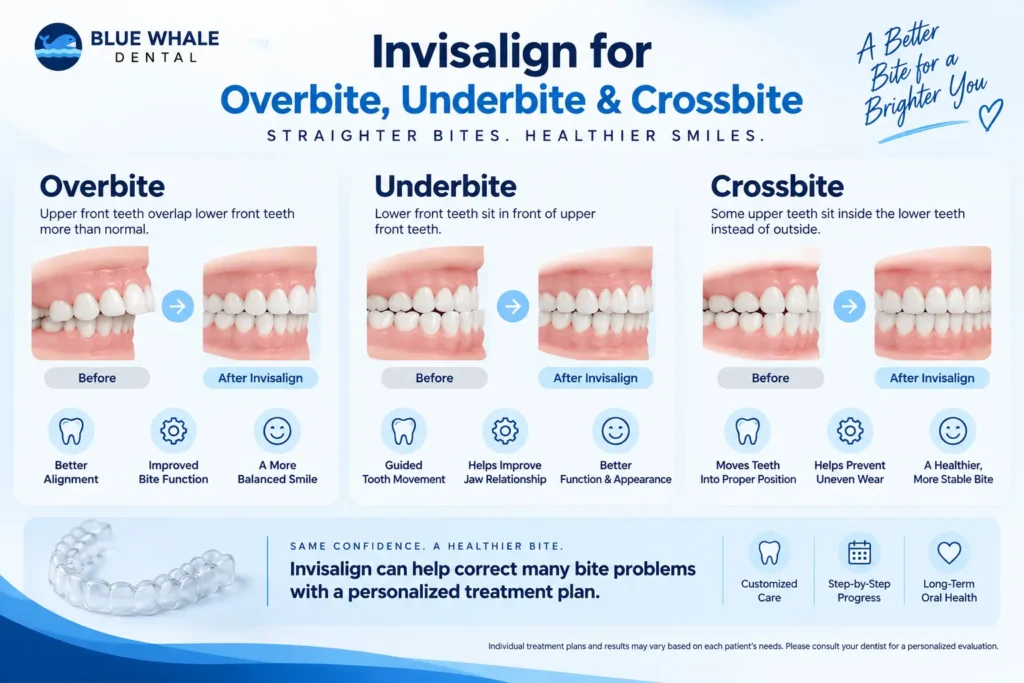
An overbite happens when the upper front teeth overlap the lower front teeth too much. A small amount of overbite is normal, but a deep overbite can cause the lower teeth to bite into the roof of the mouth or wear down the front teeth over time.
Underbite
An underbite occurs when the lower front teeth sit in front of the upper front teeth. This often happens because the lower jaw is larger, the upper jaw is smaller, or both. Underbites can affect chewing, facial balance, and speech.
Crossbite
A crossbite means some upper teeth sit inside the lower teeth instead of outside them. This can affect one tooth, several teeth, or an entire side of the bite. Crossbites may cause uneven wear, gum stress, and shifting of the jaw over time.
Can Invisalign Fix Overbite?
In many cases, yes. Invisalign can often improve mild to moderate overbites, especially when the problem is related to tooth position rather than severe jaw structure differences.
When people search for Invisalign Fix Overbite, they are usually asking whether clear aligners can move the upper and lower teeth into a healthier relationship. For many patients, the answer is yes, but the treatment plan needs to be customised.
How Invisalign helps correct an overbite?
Invisalign may address an overbite by:
- Moving the front teeth into better alignment
- Changing how the upper and lower arches fit together
- Creating space for proper tooth movement
- Using attachments to improve grip on certain teeth
Using elastics in some cases to guide bite correction
When Invisalign works best for overbite?
Invisalign tends to work best when the overbite is caused mainly by tooth positioning, crowding, or a slightly deep bite. It can be very effective for adults and teens who have healthy gums and are able to wear aligners as directed.
When Invisalign may not be enough?
If the overbite is caused by significant jaw growth differences or a severe skeletal issue, aligners alone may not fully correct it. In those cases, an orthodontist may recommend braces, elastics, or in rare situations, jaw surgery in addition to orthodontic treatment.
Can Invisalign Fix Underbite?
Yes, Invisalign can sometimes correct mild to moderate underbites, but underbites are often more complex than overbites. Whether Invisalign is the right option depends on whether the problem is dental, skeletal, or both.
Types of underbite cases Invisalign may treat:
Invisalign may be used for:
- Mild underbites caused by tooth position
- Functional shifts where the jaw moves forward when biting
- Bite asymmetries with limited skeletal involvement
- Cases where elastics can help guide the jaw relationship
Why underbites can be more challenging?
Underbites are often linked to jaw size or jaw position. If the lower jaw is significantly forward or the upper jaw is significantly underdeveloped, aligners may improve the bite but not completely resolve the underlying structure.
Tradeoffs to consider:
With underbite treatment, some patients may need:
- More time in treatment
- Elastics worn consistently
- Attachments on multiple teeth
- Refinement aligners toward the end of treatment
- A different orthodontic appliance if the case is severe
So while Invisalign can be a strong option, an in-person evaluation is important to determine whether it can fully address the underbite or only improve it.
Can Invisalign Fix Crossbite?
In many cases, yes. Invisalign is often a good treatment choice for mild to moderate crossbites, especially when the problem is related to tooth alignment.
How Invisalign may correct a crossbite?
Clear aligners can gradually move teeth outward or inward to help the upper teeth sit properly outside the lower teeth. Depending on the case, Invisalign may also use:
- Precision attachments
- Elastics
- Gentle arch expansion
- Strategic tooth movement to rebalance the bite
Why does crossbite treatment matter?
A crossbite may not seem urgent if it is not causing pain, but untreated crossbites can lead to:
- Uneven tooth wear
- Chipped enamel
- Gum recession on certain teeth
- Jaw strain
- Shifting bite patterns over time
Treating a crossbite early can help prevent long term problems and improve the stability of your bite.
What Invisalign Can and Cannot Do?
Invisalign is a highly effective orthodontic system, but it is not a universal fix for every bite issue.
Invisalign can often:
- Straighten crooked teeth
- Correct mild to moderate bite issues
- Improve overbite, underbite, and crossbite in many cases
- Make treatment more discreet than metal braces
- Offer a removable option for eating and brushing
Invisalign may not be ideal for:
- Severe skeletal bite discrepancies
- Cases needing major jaw correction
- Patients who cannot wear aligners for 20 to 22 hours a day
- Certain complex rotations or vertical tooth movements
- Some older bite problems with extensive tooth wear or shifting
The best results come from a personalized plan created by a dental professional who understands how tooth movement affects the full bite, not just the appearance of the front teeth.
What to Expect During Invisalign Bite Correction?
If you are considering Invisalign for an overbite, underbite, or crossbite, the treatment process usually follows several steps.
1. Consultation and bite evaluation
Your provider will examine your teeth, gums, jaw, and bite relationship. Digital scans or impressions may be taken to map your teeth and plan movement.
This stage is important because bite correction is more than cosmetic alignment. The goal is to improve how your teeth function together as well as how they look.
2. Customized treatment planning
A digital treatment plan is created based on your bite needs. Your provider can show a preview of how the teeth may move over time, and explain whether attachments, elastics, or other tools will be part of the process.
3. Wearing aligners
You will wear each aligner set for about one to two weeks, depending on your treatment plan. The aligners should be worn 20 to 22 hours per day to stay on track.
4. Progress checks
Regular follow-up visits allow your provider to monitor progress and make adjustments if necessary. If the bite is not shifting as expected, refinements may be needed.
5. Refinement phase
Many bite cases need refinement aligners near the end of treatment. This is normal and helps improve the final fit of the teeth and bite.
6. Retainers
Once treatment is complete, retainers are essential. Teeth can shift again if retainers are not worn as directed. Long term retention is especially important after bite correction.
Invisalign vs Braces for Bite Correction
Feature | Invisalign | Braces |
|---|---|---|
Appearance | Nearly invisible | Visible metal or ceramic brackets |
Removability | Removable for meals and brushing | Fixed in place |
Comfort | Smooth plastic, fewer mouth irritations | Can cause bracket and wire irritation |
Hygiene | Easier to brush and floss | More difficult to clean around brackets |
Bite correction | Effective for many mild to moderate cases | Often preferred for complex or severe cases |
Compliance | Requires strong patient discipline | Works continuously once placed |
Flexibility | Good for many modern orthodontic cases | Often better for major tooth movement |
Invisalign is often preferred by adults who want a discreet option and are able to wear aligners consistently. Braces may be recommended when a bite issue is more severe or requires more complex mechanical control.
How Long Does Invisalign Take for Bite Issues?
Treatment time depends on the severity of the bite issue, how much tooth movement is required, and how consistently the aligners are worn.
In general:
- Mild cases: 6 to 12 months
- Moderate cases: 12 to 18 months
- Complex cases: Can take 24+ months
If elastics or additional orthodontic tools are needed, treatment may take more time. The timeline is different for every patient, and bite correction usually requires more planning than simple tooth straightening.
Benefits of Choosing Invisalign for Bite Problems
For the right patient, Invisalign offers several advantages:
Discreet appearance
Aligners are much less noticeable than braces, which is appealing for adults and teens who want a subtle treatment option.
Better oral hygiene
Because the trays are removable, it is easier to brush and floss normally.
Fewer food restrictions
You remove the aligners when eating, so there are no bracket-related food limitations.
Comfortable design
The smooth plastic trays are generally more comfortable than wires and brackets.
Digital planning
Modern Invisalign treatment uses precise digital planning to map tooth movement and monitor progress.
Potential Challenges and Limitations
It is also important to understand the tradeoffs.
Alignment depends on compliance
If you do not wear the aligners enough, treatment can stall or become less effective.
Some bite corrections need elastics
Patients who want a completely attachment-free or elastic-free treatment may not be ideal candidates for bite correction.
Refinements are common
It is normal to need extra aligners at the end of treatment to improve the bite.
Severe jaw issues may need another approach
If the bite problem is primarily skeletal, Invisalign alone may not create the best result.
Who Is a Good Candidate for Invisalign Bite Correction?
You may be a good candidate if you:
- Have a mild to moderate overbite, underbite, or crossbite
- Want a discreet treatment option
- Can commit to wearing aligners consistently
- Have healthy teeth and gums
- Are looking for an orthodontic option that supports easier brushing and flossing
A consultation is the best way to determine candidacy, because a bite problem that looks mild may still require more advanced treatment.
Bite Issue | Can Invisalign Help? | Best for |
|---|---|---|
Overbite | Yes, often | Mild to moderate dental overbites |
Underbite | Sometimes | Mild to moderate underbites |
Crossbite | Yes, often | Dental crossbites and mild cases |
Conclusion
Invisalign can be an effective treatment for overbite, underbite, and crossbite in many cases, especially when the issue is mild to moderate and mostly related to tooth alignment. For more complex bite problems, however, Invisalign may need to be combined with elastics, attachments, or a different orthodontic approach.
If you are wondering whether Invisalign Fix Overbite is possible for your smile, the most reliable answer comes from a personalized evaluation. A careful bite assessment can determine whether clear aligners are the right solution or whether another treatment will produce a healthier, more stable result.
Frequently Asked Questions About Invisalign
Can Invisalign fix overbite completely?
In many mild to moderate cases, yes. For severe overbites caused by jaw differences, Invisalign may improve the bite but not fully correct it on its own.
Is Invisalign good for underbite?
It can be, especially when the underbite is mild or dental in nature. More severe underbites may need braces, elastics, or other orthodontic treatment.
How do I know if Invisalign can fix my crossbite?
A professional exam is the best way to know. Your provider will look at whether the crossbite is caused by tooth position or jaw structure, which affects the treatment plan.
Does Invisalign work faster than braces for bite issues?
Not always. Some cases are similar in length, while complex bite problems may take longer with aligners. The right option depends on your specific needs.
Will I need attachments or rubber bands?
Possibly. Many bite correction cases with Invisalign use attachments, and some also require elastics to help guide jaw and tooth movement.
Is Invisalign painful for bite correction?
You may feel pressure when switching trays, especially during the first few days of a new set. This is usually temporary and a sign the teeth are moving.
Why Midtown Manhattan Professionals Choose Blue Whale Dental
If you are considering Invisalign for bite correction, Blue Whale Dental can help you understand your options and create a treatment plan tailored to your smile. Schedule a consultation today to find out whether Invisalign is the right choice for your overbite, underbite, or crossbite.
At Blue Whale Dental NYC, we provide advanced and personalized solutions for missing teeth, including implants, bridges, and full restorative care tailored to your needs.
Ready to book your dentist appointment in Midtown NYC Visit our clinic or schedule your appointment today with our expert dental team.
Address: 10 W. 46th Street #1402 New York, NY 10036
Email: info@bluewhaledental.com
Call Now : 212-752-1252