
Professional teeth whitening is increasingly moving beyond the dental chair. In 2026, Philips expanded its professional take-home whitening offering in the U.S. with Philips Zoom! Delivered, a service that connects dentist-guided treatment planning with custom whitening trays that are produced through a lab workflow and shipped to the patient. Philips says the process can allow patients to begin professional take-home whitening without having the custom trays manufactured in the dental office.
But a take-home whitening kit is not simply a stronger version of an over-the-counter whitening strip. The appropriate product, tray design, peroxide formulation, treatment schedule, and aftercare depend on the patient’s teeth, existing dental work, sensitivity, and cosmetic goals.
For Midtown Manhattan – NYC patients considering professional whitening, the important question is not simply “Which whitening kit is strongest?” It is “Which whitening approach is appropriate for my smile?”
This guide explains what changed with Philips Zoom in 2026, how Zoom compares with Philips Sonicare take-home whitening, what DayWhite and NiteWhite mean, how dentist-guided whitening can fit into a larger cosmetic treatment plan, and what patients should know before whitening at home.
Considering professional whitening in Midtown NYC?
A dental evaluation can help determine whether in-office whitening, take-home whitening, or another cosmetic option is appropriate for your smile.
Book a Whitening Consultation in Midtown anhattan
What Is Philips Zoom Take-Home Whitening?
Philips Zoom Take-Home Whitening is a professional whitening system designed to let patients whiten their natural teeth at home using dentist-guided treatment and whitening trays.
Unlike many over-the-counter whitening products, professional take-home whitening is incorporated into a dental treatment plan. Depending on the system, the trays may be professionally fabricated or use a semi-custom design that the patient molds at home. Philips offers different formulations and treatment schedules, including hydrogen peroxide and carbamide peroxide options.
The basic process typically involves:
- Evaluating the patient’s teeth and gums.
- Discussing the desired shade and treatment goals.
- Selecting an appropriate whitening formulation.
- Providing or creating the appropriate tray.
- Applying the recommended amount of whitening gel.
- Wearing the trays according to the recommended schedule.
- Monitoring sensitivity and gum comfort.
- Adjusting or following up on treatment when necessary.
Philips currently describes its Zoom take-home system as offering flexible treatment schedules ranging from approximately 30 minutes per day to overnight, depending on the formulation.
That flexibility is one reason take-home whitening can appeal to patients who want professional treatment but prefer to manage much of the process around their own schedule.
What Changed With Philips Zoom Take-Home Whitening in 2026?
The biggest development is Philips Zoom! Delivered.
On April 2, 2026, Philips announced the U.S. expansion of Zoom! Delivered, a workflow designed to allow dental professionals to plan professional take-home whitening while having custom trays produced through the Philips lab and shipped directly to the patient.
According to Philips, the workflow works roughly like this:
1. The dentist evaluates the patient
The dental professional determines whether professional whitening is appropriate and discusses the available treatment options.
2. An intraoral scan is taken
The patient’s teeth are digitally scanned to provide the information needed for the custom tray.
3. The scan is sent to the Philips lab
Philips uses the digital information to produce the custom whitening trays.
4. The whitening formulation is selected
Philips currently describes Zoom! Delivered as offering DayWhite and NiteWhite options, with the formulation and wear schedule selected as part of the professional treatment process.
5. The kit is shipped to the patient
Philips says the custom trays and selected whitening gel can be delivered to the patient’s home within approximately 10 business days.
6. Whitening continues at home
The patient follows the instructions provided by the dental professional and product manufacturer.
This is important for patients because it illustrates how professional whitening is evolving: the treatment can increasingly combine digital dentistry, custom trays, professional guidance, and at-home convenience.
However, Philips is offering Zoom! Delivered does not automatically mean every dental practice offers the service. Patients should confirm which products and workflows are actually available through their dental office.
Philips Zoom Take-Home vs. Philips Sonicare Take-Home Whitening
One source of confusion is that Philips Zoom and Philips Sonicare both have professional take-home whitening products.
They are related to the same broader Philips professional whitening ecosystem, but they are not identical products.
Philips currently distinguishes between:
Philips describes Zoom take-home as using professionally made custom trays, while Sonicare Take-Home uses trays that patients mold at home.
Feature | Philips Zoom Take-Home | Philips Sonicare Take-Home |
Tray type | Custom professional tray | Semi-custom/moldable tray |
Tray process | Professionally fabricated | Patient molds tray at home |
Home treatment | Yes | Yes |
Whitening options | DayWhite / NiteWhite | Advanced / Caring |
Peroxide type | Hydrogen peroxide or carbamide peroxide, depending on product | Hydrogen peroxide |
Treatment schedule | Depends on formulation | Product-specific |
Professional involvement | Treatment planning and guidance | Designed as a dental-practice supplied system |
Main distinction | Customized professional tray system | Convenient semi-custom home tray |
Philips says the Sonicare system allows patients to mold the trays at home and reuse them. Its current professional page lists an Advanced kit with claims of up to five shades of whitening, with first results in three days and full results after nine days.
The important takeaway is that Philips Sonicare Take-Home is not simply another name for Philips Zoom Take-Home.
If you have seen the Philips Sonicare Advanced or Caring kits online or in a dental office, they should not automatically be assumed to be the same system as a custom Philips Zoom take-home treatment.
What Comes in a Philips Sonicare Take-Home Whitening Kit?
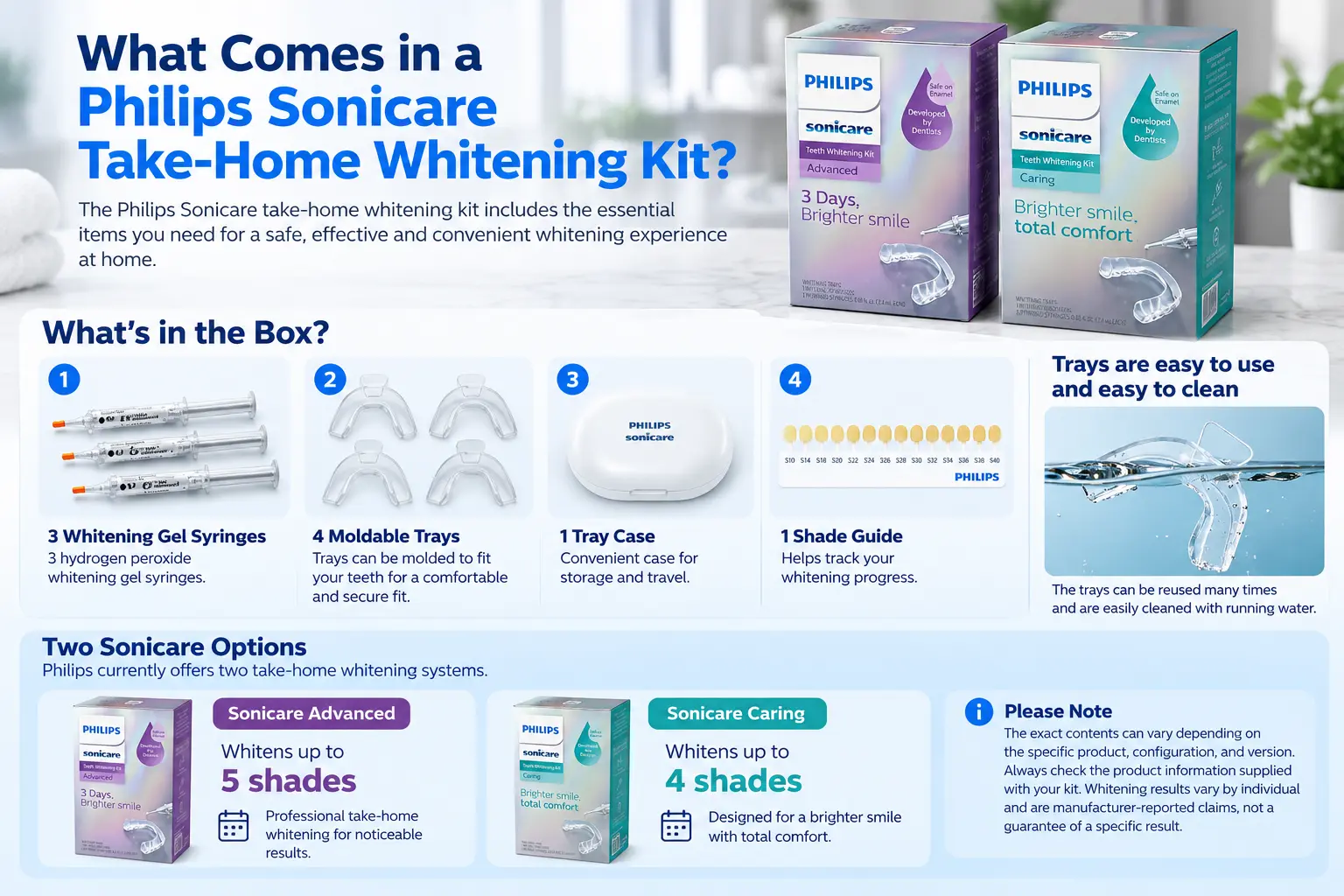
For the current Philips Sonicare kit listed on Philips’ professional website, the package includes:
- 3 hydrogen peroxide whitening gel syringes
- 4 moldable trays
- 1 tray case
- 1 shade guide
Philips notes that the trays can be molded to fit the patient’s teeth and cleaned with running water.
The exact contents can vary depending on the specific product, configuration, and version, so patients should check the product information supplied with their kit rather than assuming every Philips whitening package contains the same components.
Philips currently lists both Sonicare Advanced and Sonicare Caring systems. The manufacturer says Advanced can whiten up to five shades, while Caring can whiten up to four shades.
These are manufacturer-reported product claims, not a guarantee of the result an individual patient will achieve.
Philips Zoom DayWhite vs. NiteWhite: What's the Difference?
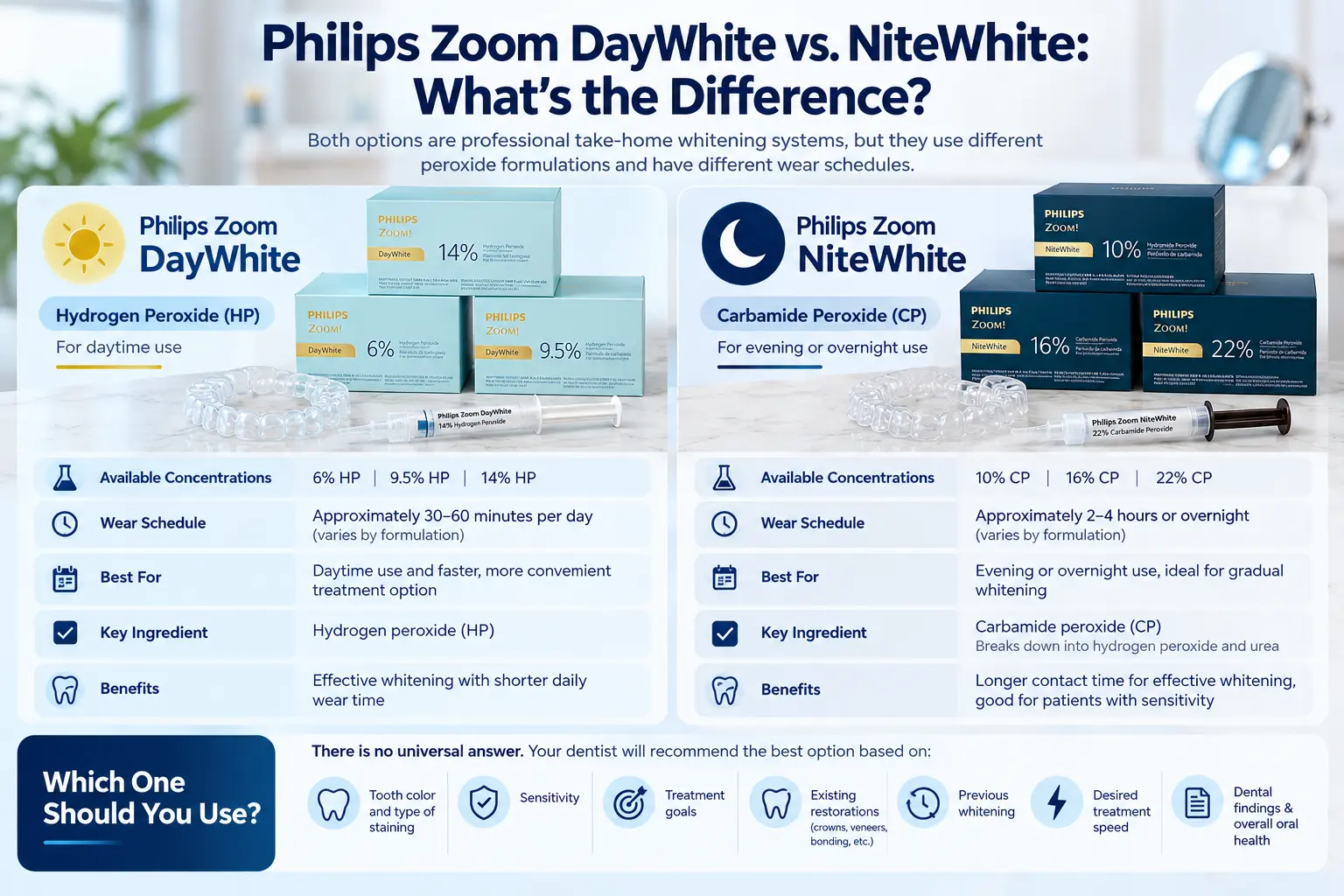
Another important distinction is between Philips Zoom DayWhite and Philips Zoom NiteWhite.
The primary difference is the active peroxide formulation and the expected wear schedule.
Philips Zoom DayWhite
DayWhite uses hydrogen peroxide (HP).
Philips currently lists DayWhite formulations including:
The recommended wear schedule varies by formulation. Philips lists schedules ranging from approximately 30 minutes to 60 minutes per day, depending on the specific product.
Philips Zoom NiteWhite
NiteWhite uses carbamide peroxide (CP).
Philips currently lists:
Depending on the formulation, Philips lists treatment schedules ranging from two to four hours to overnight use.
Carbamide peroxide breaks down into hydrogen peroxide and urea, allowing the active peroxide to work over a longer period.
Which one should you use?
There is no universal answer.
The appropriate formulation and schedule should be selected based on factors such as:
- tooth color and type of staining
- sensitivity
- treatment goals
- existing restorations
- previous whitening
- desired treatment speed
- dental findings
A dentist can recommend the appropriate formulation and wear schedule rather than having a patient choose a peroxide concentration based solely on an online product description.
Can Philips Zoom Take-Home Whitening Be Used After In-Office Whitening?
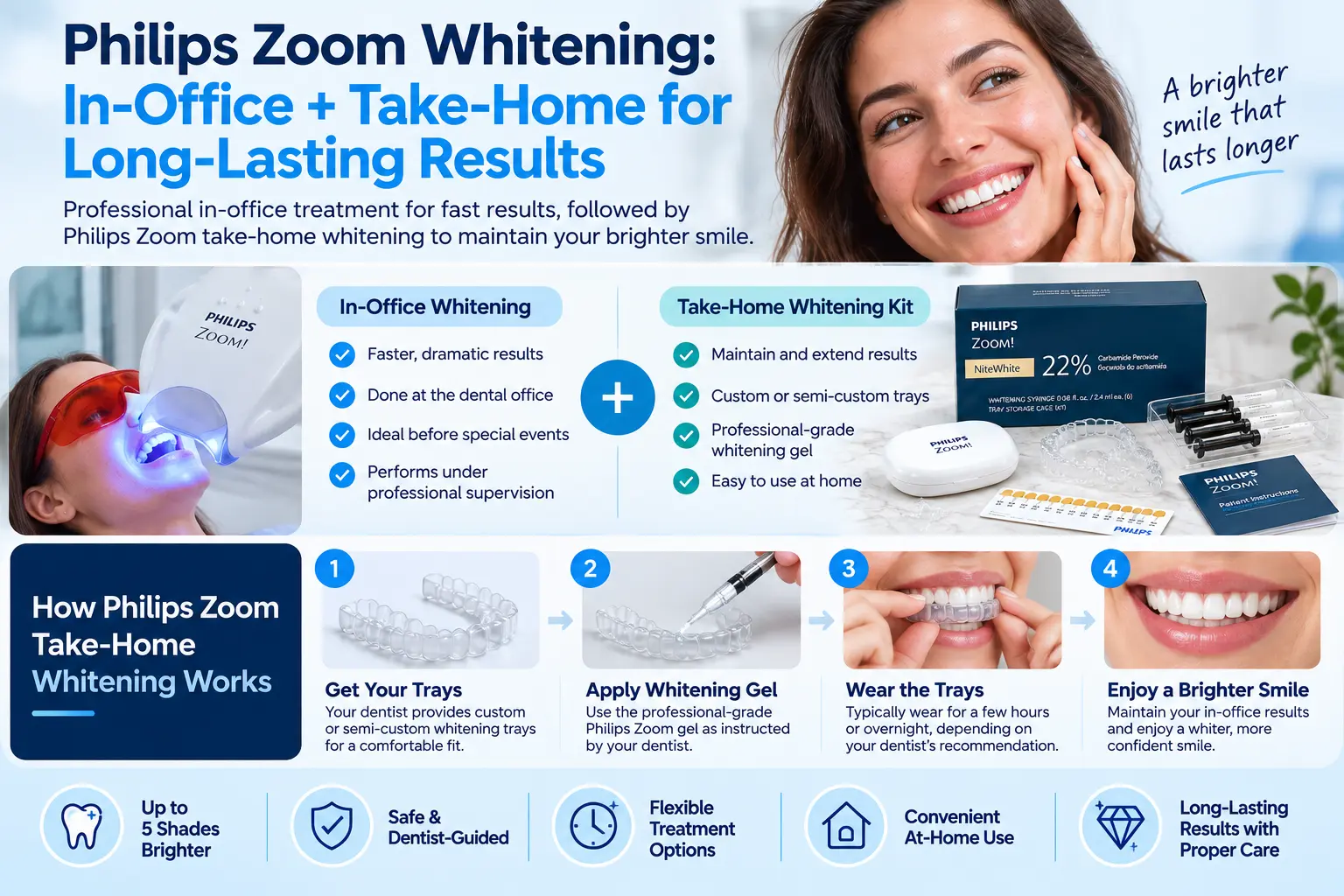
Professional take-home whitening can be incorporated into a broader whitening plan for some patients, including maintenance or additional whitening after an in-office treatment. However, the timing and product should be determined by the dental professional.
Take-home whitening may have several potential roles:
- maintaining a brighter shade
- performing periodic touch-ups
- gradually improving the shade after initial treatment
- supporting a longer-term whitening plan
- preparing for an upcoming event
- addressing shade changes over time
That does not mean every patient needs a take-home kit after in-office whitening.
The right approach depends on the patient’s starting shade, whitening response, sensitivity, dental restorations, oral health, and cosmetic objectives.
A professional whitening plan may involve one method or a combination of approaches depending on those factors. A 2024 systematic review found that both in-office and at-home professional whitening can effectively change tooth color, while the available evidence does not establish one universal protocol as best for every patient.
If you are considering a combination of in-office and take-home whitening, discuss the timing with your dentist rather than immediately starting another whitening product.
Why Does a Whitening Consultation Come First?
Whitening is a cosmetic procedure, but that does not mean every discolored tooth should immediately be treated with peroxide.
Before whitening, a dental professional may need to consider:
- cavities
- cracked teeth
- gum inflammation
- enamel condition
- tooth sensitivity
- existing restorations
- crowns
- veneers
- bonding
- previous whitening
- the type of discoloration
- the desired shade
- realistic treatment expectations
A dental examination can help identify problems that may need attention before cosmetic whitening.
For example, if a patient has untreated decay or significant gum inflammation, whitening may not be the first priority.
Likewise, if visible crowns, veneers, or bonding are present, whitening the natural teeth may create a shade mismatch because restorative materials do not whiten in the same way as natural teeth.
For patients considering treatment in Midtown Manhattan, a dental examination at Blue Whale Dental can provide an opportunity to evaluate the teeth, gums, restorations, and overall oral health before deciding on a cosmetic treatment.
Not sure which whitening option is right for you?
A whitening consultation can help determine whether in-office whitening, professional take-home whitening, or another cosmetic treatment better fits your teeth and goals.
Can Take-Home Whitening Cause Sensitivity?
Yes. Some patients experience temporary tooth sensitivity during or after whitening.
The American Dental Association explains that peroxide-based whitening can cause tooth sensitivity because peroxide can move through enamel and dentin and irritate the tooth’s nerves. The sensitivity is usually temporary, but overuse of whitening products can damage enamel or gums.
Philips also acknowledges that some users may experience temporary sensitivity with its whitening products.
This is why statements such as “zero sensitivity” or “completely pain-free” are inappropriate as universal promises.
Instead, a more accurate expectation is:
Some patients experience temporary sensitivity, and a dental professional can help modify the whitening approach if sensitivity occurs.
Sensitivity can be influenced by the product formulation, concentration, treatment frequency, existing sensitivity, enamel and dentin characteristics, and individual response.
Gum irritation can also occur if whitening gel contacts the gingival tissue. Proper tray fit and appropriate gel application are therefore important.
Can You Whiten Crowns, Veneers, or Dental Bonding?
This is one of the most important questions to answer before starting whitening.
Natural teeth
Professional whitening can lighten the color of natural teeth by acting on stain molecules.
Crowns and veneers
Crowns and veneers do not whiten in the same way as natural tooth enamel.
Dental bonding
Composite bonding also does not respond to peroxide whitening in the same way as natural teeth.
The ADA specifically notes that whitening does not work on caps, veneers, crowns, or fillings.
That means patients with visible restorations should discuss whitening before treatment.
For example, if natural teeth are whitened after a front tooth has been restored with bonding, the natural teeth may become lighter while the existing restoration remains at its original shade.
In some cases, the cosmetic treatment plan may therefore involve whitening first and then reassessing whether existing restorations need to be replaced or adjusted.
If discoloration or tooth shape is part of the concern, cosmetic dentistry in Midtown Manhattan may offer additional treatment options. For smaller cosmetic changes, teeth bonding may also be considered depending on the tooth and clinical situation.
Philips Zoom Take-Home Whitening vs. Whitening Strips
Patients often compare professional take-home whitening with inexpensive whitening strips.
They are not necessarily equivalent treatment approaches.
Factor | Dentist-Guided Take-Home Whitening | OTC Whitening Strips |
Dental evaluation | Yes | Usually no |
Treatment planning | Personalized | General |
Tray customization | Depending on system | No |
Whitening formulation | Professional system | Consumer product |
Sensitivity guidance | Dental professional can provide guidance | Usually self-managed |
Existing restorations | Can be assessed | Usually not assessed |
Follow-up | Possible | Usually limited or none |
This does not mean over-the-counter whitening products are automatically unsafe. The ADA recognizes at-home bleaching products and recommends discussing whitening options with a dentist; it also recommends looking for the ADA Seal of Acceptance where applicable.
The major difference is professional assessment and treatment planning.
A patient with healthy, uniformly stained natural teeth may have different needs from someone with sensitive teeth, gum disease, crowns, veneers, bonding, or significant intrinsic discoloration.
Who Is a Good Candidate for Philips Zoom Take-Home Whitening?
Potential candidates for professional take-home whitening may include patients who have:
- generally healthy teeth and gums
- cosmetic tooth discoloration
- yellowing associated with aging or lifestyle staining
- a preference for gradual whitening
- a desire to maintain previous whitening results
- a preference for completing treatment at home
- realistic expectations about the final shade
Coffee, tea, red wine, tobacco, and other lifestyle factors can contribute to tooth staining over time.
However, a dental evaluation is necessary to determine whether whitening is appropriate for an individual patient.
Whitening is designed primarily for natural teeth, and the type and cause of discoloration can affect the expected response.
Who May Need Another Approach?
Take-home whitening may not be the first choice for every patient.
A dentist may recommend addressing another issue first when there is:
- untreated tooth decay
- active gum inflammation or disease
- significant tooth sensitivity
- a cracked or damaged tooth
- certain types of intrinsic discoloration
- extensive visible restorations
- unrealistic expectations about whitening
- discoloration caused by trauma or medication
The ADA notes that whitening does not correct every type of tooth discoloration and may not work effectively on gray-toned teeth, medication-related discoloration, tooth injury, or restorations.
In those situations, alternatives may include restorative or cosmetic treatment rather than simply increasing the whitening strength.
How Long Do Philips Zoom Whitening Results Last?
There is no reliable universal number of months that every patient should expect.
Whitening results can change over time because teeth are naturally exposed to staining foods, beverages, tobacco, aging, and other factors.
Longevity can be influenced by:
- coffee consumption
- tea
- red wine
- tobacco
- diet
- oral hygiene
- age
- natural tooth color
- type of staining
- maintenance whitening
- individual tooth characteristics
The goal should therefore not be to promise a fixed duration of whitening.
Instead, patients should think of whitening as part of an ongoing cosmetic maintenance plan.
How to Maintain Whitening Results?
Once you have reached your desired shade, good oral care and appropriate maintenance can help preserve the appearance of your smile.
1. Brush twice a day
Use a fluoride toothpaste and a soft-bristled toothbrush unless your dentist recommends something different.
2. Clean between your teeth
Flossing or another appropriate interdental cleaning method helps maintain the health and appearance of the areas between teeth.
3. Keep up with professional dental care
Professional cleanings and regular examinations can help identify new staining, decay, gum problems, and other issues.
You can learn more about the role of regular dental checkups in maintaining long-term oral health.
4. Follow your whitening instructions
Do not automatically increase treatment frequency because you want faster results.
More whitening is not necessarily better.
5. Avoid indefinite use of leftover gel
Whitening products should be used according to the manufacturer’s instructions and the treatment plan provided by your dental professional.
6. Discuss touch-up whitening
Some patients may benefit from periodic maintenance whitening. Your dentist can determine whether additional treatment is appropriate and when it should be performed.
What Does Current Evidence Say About Professional Take-Home Whitening?
Philips’ product information includes manufacturer-sponsored testing and clinical studies supporting the performance and safety of its whitening systems. For example, Philips reports clinical testing of different hydrogen peroxide and carbamide peroxide formulations over approximately two weeks.
These findings are useful when understanding the manufacturer’s products, but they should be distinguished from independent evidence.
A 2024 systematic review of professional tooth whitening examined 30 studies involving in-office, at-home, and combined whitening approaches. It found that professional whitening treatments generally improved tooth color, while sensitivity remained a possible side effect and the evidence did not establish one universal whitening approach as superior for every patient.
That distinction matters:
Philips’ product claims describe specific Philips products and studies. Independent research looks more broadly at professional whitening approaches.
A responsible whitening decision should consider both the product information and the patient’s individual dental condition.
Philips Zoom Take-Home Whitening in Midtown Manhattan
For patients in Midtown Manhattan, take-home whitening can be convenient when you want professional guidance without returning to the dental chair for every whitening session.
The first step should still be an evaluation of your teeth, gums, existing restorations, sensitivity, and cosmetic goals.
Blue Whale Dental currently offers both in-office and take-home whitening options through its Midtown Manhattan dental practice.
You can explore professional teeth whitening in Midtown Manhattan to learn more about the available approach.
If your whitening concern involves crowns, veneers, bonding, tooth shape, or other cosmetic issues, a broader cosmetic dentistry consultation may also be appropriate.
Importantly, the availability of a particular Philips product or Philips Zoom! Delivered workflow should be confirmed with the dental office before assuming that a specific kit or service is offered.
Frequently Asked Questions About Philips Zoom Take-Home Whitening
What is Philips Zoom take-home whitening?
Philips Zoom take-home whitening is a professional whitening system that allows patients to whiten their natural teeth at home using professional whitening gel and trays selected or provided as part of a dentist-guided treatment plan. Philips offers both custom-tray and semi-custom approaches within its professional whitening portfolio.
Is Philips Zoom take-home whitening safe?
Philips reports that its Zoom whitening systems have been tested for enamel safety, but tooth sensitivity and gum irritation can occur with whitening. The ADA also identifies temporary sensitivity as a possible side effect and recommends following product directions and discussing whitening with a dentist.
How long does Philips Zoom take-home whitening take?
Treatment time depends on the specific formulation. Philips currently lists Zoom DayWhite options with shorter daily wear periods and NiteWhite options that can involve several hours or overnight use. Some Philips product protocols describe treatment over approximately nine to fourteen days, depending on the formulation.
How many shades can Philips Zoom whitening lighten teeth?
The manufacturer's reported results vary by product and protocol. Philips currently states that certain Zoom take-home protocols can produce up to nine shades of whitening after 14 days, while other formulations have different claims. These figures are product-specific and should not be treated as a guaranteed result for every patient.
Can I use Philips Zoom whitening after in-office whitening?
Professional take-home whitening can be incorporated into a maintenance or additional-whitening plan for some patients. However, the timing, product, and frequency should be determined by the dental professional who evaluated your teeth.
What is the difference between Philips Zoom DayWhite and NiteWhite?
DayWhite uses hydrogen peroxide and is designed for shorter wear periods, while NiteWhite uses carbamide peroxide and generally involves longer wear periods. Philips offers multiple concentrations and protocols within each category.
What is the difference between Philips Zoom and Philips Sonicare whitening kits?
Philips Zoom take-home systems include professionally made custom-tray options, while Philips Sonicare Take-Home uses moldable semi-custom trays that patients fit at home. They are separate products within Philips' professional whitening portfolio.
Does Philips Zoom whitening cause sensitivity?
Some patients experience temporary sensitivity during or after whitening. Sensitivity varies between individuals and can be influenced by the formulation, treatment schedule, and individual dental characteristics.
Can I whiten my teeth if I have crowns or veneers?
You may still be able to whiten your natural teeth, but crowns and veneers do not whiten like natural teeth. This can create a shade mismatch, so patients with visible restorations should discuss their cosmetic plan with a dentist before whitening.
Can I use take-home whitening if I have sensitive teeth?
Possibly, but sensitivity should be discussed before treatment. Your dentist may recommend a different product, schedule, or approach depending on the cause and severity of your sensitivity.
How often can I use take-home whitening?
There is no single schedule that applies to every patient. Follow the instructions for the specific whitening product and your dental professional's recommendations rather than increasing frequency on your own.
Do I need a dental consultation before take-home whitening?
Professional take-home whitening should be planned around your oral health, existing restorations, sensitivity, and cosmetic goals. A dental examination can identify cavities, cracks, gum inflammation, and other conditions that may affect whitening.
How long does professional teeth whitening last?
The longevity of whitening varies. Coffee, tea, red wine, tobacco, diet, oral hygiene, aging, natural tooth color, and maintenance habits can all influence how long teeth remain brighter.
Can I buy Philips Zoom whitening without a dentist?
Philips Zoom is positioned as a professional whitening system. Philips' professional Zoom products are designed around dental-practice treatment planning, while the specific availability and purchasing process can vary by product and market.
Why Midtown Manhattan Professionals Choose Blue Whale Dental?
The 2026 expansion of Philips Zoom Take-Home Whitening shows how professional whitening is becoming more flexible, combining digital scanning, custom trays, professional formulations, and at-home treatment.
But technology is only one part of the decision.
Your tooth color, sensitivity, oral health, existing crowns or veneers, previous whitening, and cosmetic goals all influence which approach makes sense. A dentist can help determine whether in-office whitening, professional take-home whitening, maintenance treatment, or another cosmetic option is appropriate.
For patients in Midtown Manhattan, Blue Whale Dental can evaluate your smile and discuss professional whitening options based on your individual needs.
Address: 10 W. 46th Street #1402 New York, NY 10036
Email: info@bluewhaledental.com
Call Now : 212-752-1252