
Don’t Replace a Missing Tooth may seem like a small issue at first, especially when the gap is not visible when you smile. Many people delay treatment because the area does not hurt, life gets busy, or they are unsure whether replacement is really necessary. But leaving a missing tooth untreated can affect much more than appearance, potentially influencing your bite, chewing, surrounding teeth, and overall oral health.
A Missing tooth can influence how you chew, how your teeth fit together, the health of your jawbone, and even the way your face looks over time. In some cases, one missing tooth can create a chain reaction that leads to more complex dental issues later.
If you are wondering whether replacing a missing tooth is worth it, understanding what can happen if you leave the space untreated can help you make a more informed decision. This guide explains the risks, the treatment options, and the tradeoffs that come with each approach.
Why a Missing Tooth Is More Than a Cosmetic Issue?
A tooth does not function in isolation. Each tooth helps support the one next to it and contributes to a balanced bite. When one is lost, the surrounding teeth and opposing tooth often begin to shift in response to the gap.
That movement can happen slowly, which is why people sometimes do not notice a problem right away. Over time, though, the bite can become uneven, chewing can become less efficient, and the forces in the mouth may no longer be distributed properly.
This is one of the main reasons dentists recommend replacing a missing tooth even when the gap seems manageable.
What Happens If You Don’t Replace a Missing Tooth
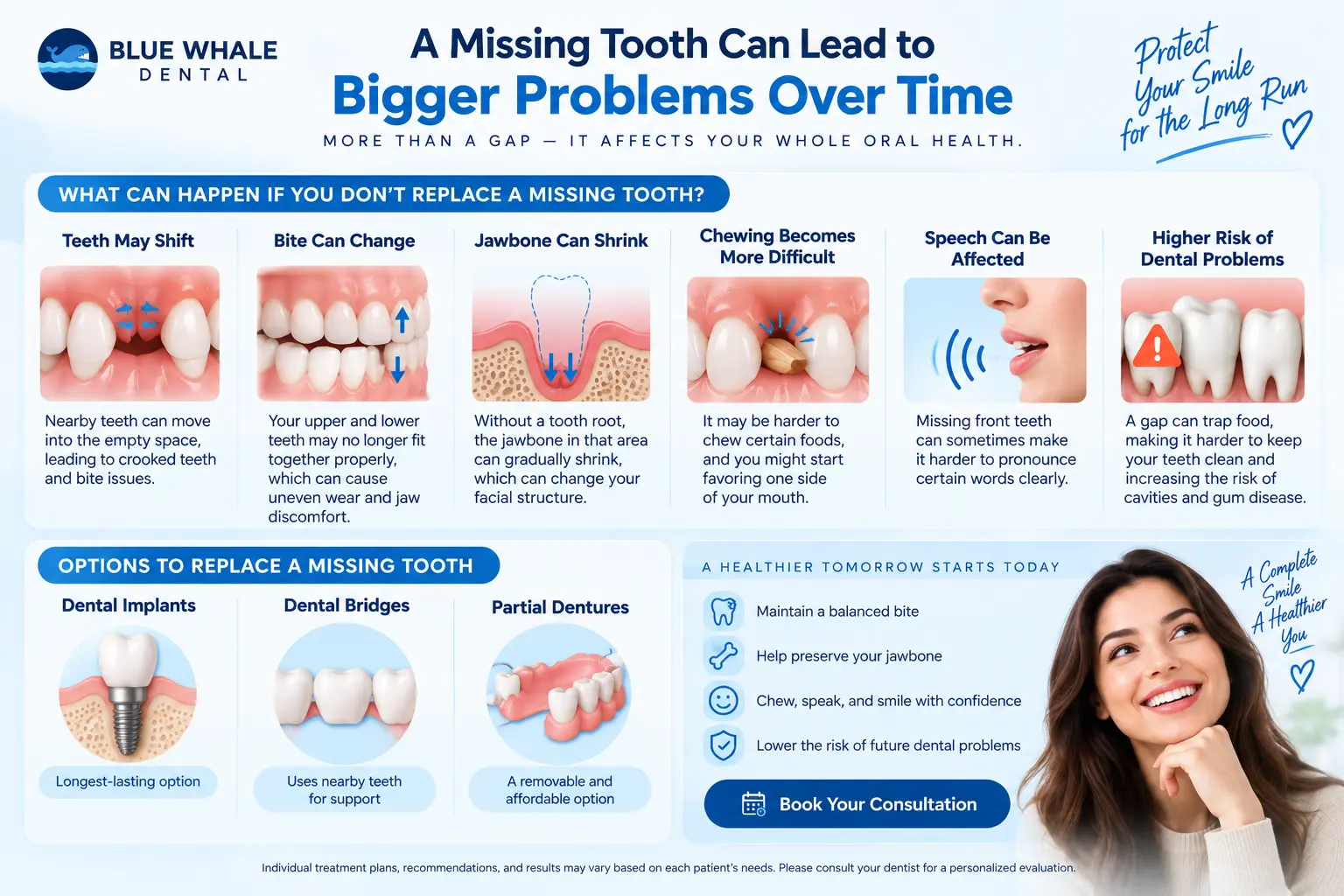
1. Nearby teeth can shift into the space
One of the most common consequences of leaving a gap is tooth movement. Teeth naturally try to maintain contact with neighboring teeth for stability. When a tooth is missing, the teeth beside it may tilt or drift into the empty space.
The tooth above or below the gap may also begin to move downward or upward. This can create:
- Crooked alignment
- Food traps between teeth
- Difficulty flossing
- Increased risk of plaque buildup
- A bite that feels less comfortable
Once teeth start shifting, it can become harder to replace the missing tooth later because the space may no longer be ideal.
2. Your bite may change
Even a single missing tooth can affect the way your upper and lower teeth meet. When the bite changes, certain teeth may take on more pressure than they should. This can cause:
- Jaw soreness
- Uneven wear on teeth
- Difficulty chewing certain foods
- Clenching or muscle tension in some cases
A bite that is out of balance can also contribute to restorations wearing down faster, including fillings, crowns, and existing dental work.
3. The jawbone can shrink over time
This is one of the most important long-term effects of tooth loss. The root of a natural tooth helps stimulate the jawbone every time you chew. When the tooth is gone, that stimulation stops.
Without that stimulation, the bone in the area begins to remodel and gradually resorb. This process is called bone loss or bone resorption. It can make the jawbone thinner and weaker over time.
Bone loss after tooth loss can lead to:
- A sunken appearance near the missing tooth
- Changes in facial shape
- Less support for nearby teeth
- More difficulty placing certain replacements later
Dental implants are unique because they help preserve bone by replacing the tooth root and stimulating the jawbone.
4. Chewing may become less efficient
People often adjust naturally when they lose a tooth, but that does not always mean function is fully restored. Depending on where the tooth is missing, chewing may feel uneven or less effective.
This can make it harder to eat certain foods, especially harder or more fibrous items. Over time, some people begin favoring one side of the mouth, which can place more stress on the remaining teeth and jaw muscles.
5. Speech may be affected in some cases
The impact on speech depends on which tooth is missing. Front teeth, especially incisors, play an important role in forming certain sounds. If one is lost and not replaced, you may notice changes in pronunciation or airflow.
Not everyone experiences noticeable speech issues, but for some patients, replacement improves clarity and confidence.
6. The risk of further dental problems increases
A missing tooth can create a vulnerable area where plaque and food debris collect more easily. If the surrounding teeth shift, oral hygiene becomes more difficult. That raises the risk of:
- Gum inflammation
- Cavities in nearby teeth
- Gum disease
- Damage to opposing teeth from uneven force
The longer a gap remains untreated, the more likely it is that additional treatment may be needed later.
Why Some People Delay Tooth Replacement
It is common to postpone treatment after tooth loss. Some people do not notice immediate discomfort, while others worry about cost, treatment time, or the invasiveness of available options.
Common reasons for delay include:
- The missing tooth is not visible
- There is no pain
- The patient is unsure which option is best
- Dental treatment costs are a concern
- They expect to address it later
The challenge is that delaying replacement often gives tooth movement and bone loss more time to progress. What starts as a simple replacement may become more complex later.
Replacement Options and Their Tradeoffs
There is no single solution for every patient. The right option depends on oral health, bone levels, location of the missing tooth, budget, and long-term goals.
Dental implants
A dental implant is a small titanium post placed into the jawbone to act like a tooth root. Once it integrates with the bone, a crown is attached to restore the visible tooth.
Benefits:
- Helps preserve bone
- Feels and functions like a natural tooth
- Does not rely on neighboring teeth for support
- Long-term solution with proper care
Tradeoffs:
- Requires surgery
- Healing time is longer
- Not ideal for every patient without enough bone or healthy gum support
- Can cost more initially
Dental bridge
A bridge replaces a missing tooth by using the neighboring teeth as support for an artificial tooth in the middle.
Benefits:
- Faster treatment timeline
- No surgery required
- Good option when adjacent teeth already need crowns
Tradeoffs:
- Requires reshaping neighboring teeth
- Does not replace the root
- Does not prevent bone loss in the gap
- May need future replacement
Partial denture
A removable partial denture can replace one or more missing teeth.
Benefits:
- Usually more affordable
- Non-surgical
- Can replace multiple teeth at once
Tradeoffs:
- Less stable than fixed options
- May feel bulkier
- Requires removal for cleaning
- Can be less comfortable for some patients
Option | Main Benefit | Main Limitation | Best For |
|---|---|---|---|
Preserves bone and restores full function | Higher upfront cost and surgery required | Patients wanting a long-term solution | |
Fixed replacement without surgery | Depends on neighboring teeth and does not stop bone loss | Patients who want a faster fixed option | |
More affordable and non-surgical | Less stable and removable | Patients replacing one or more teeth on a budget |
How Long Can You Leave a Missing Tooth Untreated?
There is no universal deadline, but the sooner you address it, the better. Tooth movement and bone loss can begin within months after tooth loss, although the speed varies from person to person.
A short delay does not always mean a major problem, but waiting too long can reduce the range of options. For example, bone loss may eventually make implant placement more complicated and require additional procedures such as bone grafting.
If you recently lost a tooth, it is wise to schedule an evaluation soon even if you are not ready to move forward right away. A dentist can assess the gap and help you understand your options before more changes occur.
What If the Missing Tooth Is in the Back?
Some patients think back teeth are less important because they are not visible. In reality, molars and premolars do a large share of chewing work. Losing one can affect bite balance, chewing efficiency, and the health of nearby teeth.
Back teeth are also important for maintaining space and vertical support in the bite. If left untreated, a missing molar can lead to shifting and excess wear just like a front tooth can.
What If You Already Have Other Dental Work?
If you already have crowns, fillings, or older bridges, the treatment choice may require more planning. A missing tooth can place different forces on existing dental work, and replacement planning needs to consider the condition of neighboring teeth.
For example, if adjacent teeth already have large restorations, a bridge may be more practical in some cases. If preserving healthy adjacent teeth is the priority, an implant may be the better option if bone and gum health allow it.
Can a Missing Tooth Affect Confidence and Quality of Life?
Yes. The impact is not only physical. Some patients become self-conscious about smiling, speaking, or eating in public. Others simply do not want their mouth to feel incomplete.
Replacing a missing tooth can improve confidence, but the emotional benefit often comes from restoring normal function as much as appearance. Many patients feel more comfortable once they no longer need to hide the gap or worry about how it affects their bite.
You should book a dental evaluation if you have a missing tooth and notice any of the following:
- Shifting teeth
- Changes in your bite
- Food getting stuck in the gap
- Jaw pain or discomfort
- Difficulty chewing
- Visible changes in the shape of your face or gums
Even if you do not have symptoms, it is still a good idea to have the area examined. A dentist can determine whether the surrounding teeth and bone are still healthy enough for the option you want.
Frequently Asked Questions About Missing Tooth
Is it okay to leave a missing tooth unreplaced?
In the short term, some people do leave a missing tooth unreplaced. However, over time it can lead to shifting teeth, bite changes, and bone loss. A dentist can help you understand the risks based on the location of the tooth.
How soon should I replace a missing tooth?
As soon as practical after healing and evaluation. The earlier you replace it, the more likely you are to preserve surrounding bone and maintain proper spacing.
Is a dental implant better than a bridge?
It depends on your needs. An implant is often preferred because it replaces the root and helps preserve bone. A bridge may be a better choice if surgery is not ideal or if nearby teeth already need crowns.
Can one missing tooth really cause problems?
Yes. Even one missing tooth can affect alignment, chewing, and jawbone health. The impact may be gradual, but it can still be significant.
Will my other teeth move if I do not replace the tooth?
They can. Adjacent teeth may tilt or drift into the gap, and the opposing tooth may shift as well. This is why open spaces should be monitored and addressed early.
Conclusion
When you don’t replace a missing tooth, the issue can progress far beyond a visible gap. Teeth may shift, your bite may change, chewing can become less efficient, and the jawbone in the area may begin to shrink. Over time, these changes can make treatment more complicated and may affect both oral health and appearance.
The good news is that modern restorative dentistry offers several reliable ways to replace a missing tooth. Whether you are considering a dental implant, bridge, or partial denture, the right solution depends on your goals, bone health, and overall dental condition.
The most important step is not to ignore the gap for too long. Early evaluation gives you more options and can help prevent more extensive treatment later.
Why Midtown Manhattan Professionals Choose Blue Whale Dental
If you have a missing tooth and want to understand the best replacement option for your smile, schedule a consultation with Blue Whale Dental. Our team can assess your oral health, explain your choices clearly, and help you choose a treatment that fits your long-term needs.
At Blue Whale Dental NYC, we provide advanced and personalized solutions for missing teeth, including implants, bridges, and full restorative care tailored to your needs.
Ready to book your dentist appointment in Midtown NYC Visit our clinic or schedule your appointment today with our expert dental team.
Address: 10 W. 46th Street #1402 New York, NY 10036
Email: info@bluewhaledental.com
Call Now : 212-752-1252